
Plovdiv & Sozopol, Bulgaria
We spent 2 weeks (a week in each) exploring the ancient towns of Plovdiv and Sozopol.
Plovdiv
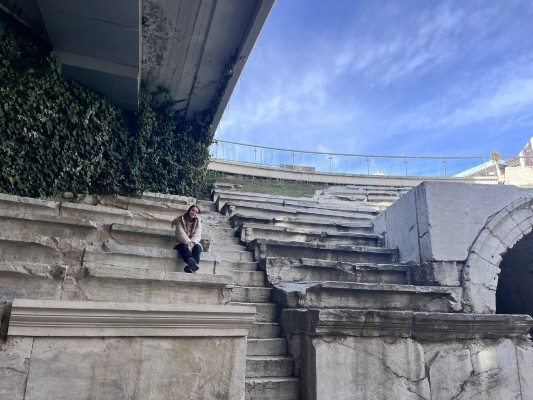
Plovdiv has a very interesting history. It claims to be the oldest living city in Europe. Its ancient name is Philippopolis and is a city which was occupied by the Macedonians, Thracians, Romans and later the Ottomans. There is an interesting video that we found that has an AI reconstruction of Plovdiv as a Roman city if you’re interested: Plovdiv video. During Roman occupation, many amazing constructs were built in the city including a fortress and walls, gates to the city, a theatre, an ampitheatre, a large stadium, a forum, temples and housing. Many of the ruins you can still see today. In fact, the Roman stadium is laying underneath the main pedestrian shopping street and you can see the ruins of it below the shops (see photo below of the ruins in the H&M clothing store)!
Here are some photos of Roman and Byzantine Philippopolis:




Mosaics
One of the buildings of interest started as a Roman temple and was later converted to a large basilica when the Roman Empire became Christian. The older temple had a mosaic floor and when it was converted to a large basilica, another (very large) mosaic floor was laid over the top of the first one. This area has been converted into a museum showing off the mosaics and giving a lot of information about the symbols found in Roman mosaics in general. In some areas, they were able to separate the two layers of floors and show them in a second level of the museum, but in most cases, you can see the lower floor below where there are cracks and holes in the upper layer. I have never before seen such incredible and large mosaic floors! Ususally when you visit Roman sites, you can only get one or two small rooms of a house with mosaic floors – this museum was incredible! Apparently the citizens of Philippopolis were very famous for creating mosaics and even created a new verb in the language meaning ‘to make mosaics’ – see sign in photo below.


Medieval and Ottoman Plovdiv
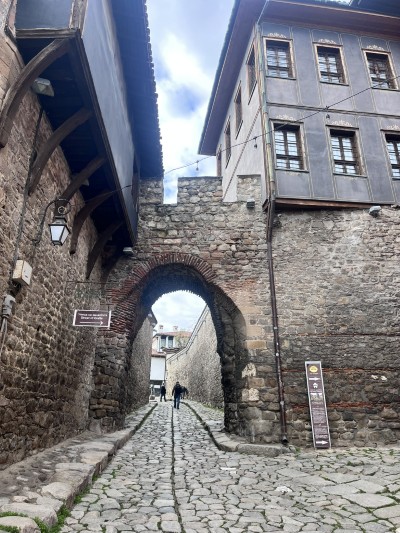
Much of the old town was built during the Middle Ages and Ottoman occupation. In some cases (see images above and below), the newer buildings were built on top of the Roman walls.


We really enjoyed Plovdiv. The city has a great vibe and it was really fun walking around the Old Town and ancient ruins. While we were there, we celebrated our 16th wedding anniversary and 20th dating anniversary.

Sozopol
We spent a week on the Black Sea exploring the town of Sozopol. Or at least, that was the plan…. Unfortunately, it seems that Sozopol is a summer place and since we were there in February, absolutely EVERYTHING was closed (except for the supermarket). I think it would be a really cool place in the summer… We did manage to spend one day walking around the old town and we spent the rest of our time relaxing and catching up on paperwork.
Sozopol also has a very interesting history. It was a town in the Thracian Empire where they traded copper mined from the nearby hills. The ancient Greeks came along and decided to live there too and name the city Apollonia in honor of the god Apollo. They built a massive fortress and temple with a big statue of Apollo. Unfortunately, the Romans came along and sacked the town, destroyed the fortress and most of the walls, stole the statue and brought it to Rome. They occupied the town for a while and traded wine and a few other things. When Christianity came, they renamed it Sozopolis (meaning City of Salvation). With the fall of the Roman Empire, the Byzantines decided to occupy it for a while and re-built the city walls. Then they battled on and off with the Bulgarians until the Ottoman Empire occupied the area.
Today, you can see the remains of the ancient Apollo temple and the Byzantine walls, but the dominant architecture is the Ottoman-style housing.


Next stop: Turkiye
Discover more from Kids Travel World
Subscribe to get the latest posts sent to your email.
Leave a Reply